8 Questions to Ask Before You Start a Sewing Business
If you want to sew products to sell at craft shows or online, it’s important to choose the right products to ensure you’ll be profitable and can build a sustainable business.
Here are the 5 questions I considered when deciding what type of sewing business to start.
1 – What are the barriers to entry?
In most locations, there are enough hoops to jump through to simply start a business (e.g. business registration, tax ID, licences and permits, etc.).
>> Here’s more information on the legal steps to take
I personally don’t want to sell a product that adds to that process.
There are certain products that have stricter regulations that manufacturers/sellers must follow.
For example, many items made for babies/children must meet strict regulations, some of which require a product to be tested. That’s not a step I want to go through each time I make a new product.
If you have a product in mind, do a quick search to find out what type of regulations you must follow.
>> Here are 6 products I wouldn’t sew to sell
There may also be other barriers to entry, outside of laws and regulations.
Also consider:
- Equipment and materials – what type of equipment do you need, and what are the costs? What type of materials will you need, and is it easy for you to access them? If they’re not available in your city/town, how much will shipping cost to buy them online?
- Price vs. profit – what’s the average price of the product you want to make and sell, and does that price allow for healthy profit margins? (Here’s how to price your products for profit).
- Market saturation and competition – will it be hard to stand out against your competition? Can you price your products to be competitive? Is there a way you can make your products/business/brand different from competitors so you stand out?
- Selling – are there enough local craft shows for you to participate in so you have constant sales? If you’re selling online, what will be the shipping fees to send products outside of your city? Will your profit margins be high enough that you can sell wholesale to retailers?
2 – Who is a good market to target?
Coming up with product ideas and making them is the easy part of running a sewing business.
Finding customers to buy those products is more difficult.
If you don’t know who (specifically) your customers are, how will you ever find them?
And if you know who your customers are but you don’t know how to (consistently) find them, how can you make sales?
Starting with a vague target market is one of the biggest mistakes new business owners make.
My first business was selling bags to women. “Women” is too vague a target market.
>> What type of bag do “women” need?
>> What materials do “women” like?
>> What type of features do “women” value the most in a bag?
The answers depend on the type of woman I’m targeting.
If it’s a new mom, they might need a diaper bag, prefer washable or wipeable materials, and value lots of pockets for organizing their items.
Think about what makes a target market “good”:
- Are they easy to find?
- Are they willing to spend money on your product? And often higher than average prices (for handmade)
- Do they have specific needs/wants you can address?
- Do you understand them/can you connect with them?
If you don’t target a good market of people, it will be hard to build a successful business.
3 – What do I enjoy making?
If you know how to sew, you can sew just about anything.
I’ve taken many sewing classes over the years and have learned to make everything from bags and stuffed toys to dresses and bras.
But some items are more enjoyable to make than others.
I personally don’t love intricate designs that require precision sewing. So I like to stay away from products and patterns that require exact cutting, pinning, seam allowances, etc. If my sewing isn’t perfectly straight, I don’t want it to compromise the quality or devalue my work.
Consider what you do and don’t enjoy sewing, and what it might feel like when you must make the same product over and over.
4 – Where is there room in the marketplace?
It’s not enough to make a product; you must make a product that stands out to consumers.
Consumers have unlimited choices these days. Once quick search online, they can find hundreds of businesses selling the product they’re seeking.
Assume your potential customers are already buying your product from another company and are satisfied with it.
What can you do to make them take a chance on an unknown business and buy from you instead?
You can make sales with a more generic product by being in the right place at the right time.
For example, sewing scrunchies in a variety of colors, prints, and materials will make me some sales at a craft show. But that business is unlikely to stand out online (e.g. my scrunchies would get lost among the thousands of scrunchie listings on Etsy) or in consumers’ minds.
If you want to grow your business and sales beyond craft shows, which is often required if you want to build a business that can partially or fully support you, you need to create a unique product that catches consumers’ attention and gets talked about.
I might make scrunchies
- for a unique target market – e.g. scrunchies for brides and their bridesmaids
- to serve a specific purpose – e.g. scrunchies for sleeping, swimming, or for people with thin hair.
- in a specific style – e.g. cottagcore style scrunchies
Research your product online, at local craft shows, and in local boutiques that might carry your products.
What will you do differently or better so your products have a chance to stand out?
5 – How do I want to sell my products?
Some products sell better through certain sales channels than others.
For example:
>> If I want to sell through boutiques, I need to have high profit margins so I can sell my products at wholesale prices and still profit. I also must be able to produce my product in high volumes, as stores often want to buy several of the same item.
>> If I want to sell online, I must sell a product that people search for online, and that can be shipped at a reasonable price.
>> If I want to sell at craft shows, my price points can’t be too high, as most craft show shoppers tend to spend $50 and under with businesses they’re unfamiliar with.
It’s also important to consider your skills and what you enjoy/don’t enjoy when it comes to sales channels.
For example, if you don’t love chatting with people or using sales tactics, selling at craft shows may drain you.
On the other hand, if you’re not tech savvy and you don’t understand most social media platforms, marketing and selling online may be a challenge.
6 – Is it useful?
The best-selling products are those that consumers need or will find useful in their lives.
Tchotchkes and trinkets can sell at craft shows, but they’re often not ideal to build a business on.
For example, a sock monkey is cute, but it’s probably going to sit on someone’s shelf and not really get “used”.
On the other hand, oven mitts and potholders are likely to be used weekly, if not daily.
A product that’s useful will get “used”, which will remind your customers of your business and is likely to encourage them to return and buy from you again.
Focusing on products that are more essential in consumers’ lives or that are evergreen (i.e. there is consistent demand for your product throughout the year) can set you up for success.
For example, sewing Christmas stockings is not evergreen as consumers only buy them in November/December. Baby products are evergreen as babies are born throughout the year, and new moms need burp cloths, bibs, and cloth diapers.
7 – Can I sew it efficiently?
To increase your profits, you’ll need to find ways to sew your items more quickly.
When you must sew dozens of the same item to prepare for a craft show, every minute counts. And the more minutes you add to the process, the higher your prices go (or the lower your profits are).
Consider if the process can be broken into steps and if those steps can be batched. Perhaps there are also tools and equipment you can invest in that will streamline the process (e.g. an industrial sewing machine so you can sew faster).
With this line of thinking, you should also consider if you want to make the item over and over.
It’s fun to sew a new product. But when you’re working with the same material, same pattern, same steps, etc., it can become monotonous. But that monotony is what helps create an efficient and profitable business.
8 – Can I build out?
Most handmade businesses start with one product/idea.
Mine first started when I made a pair of flannel pajama bottoms and a matching rice heating bag, and packaged them in a matching drawstring bag. I made it as a gift for a friend, and everyone who saw it told me I had to start selling them.
Although it could be done, it would be hard to build a business with those two items. Not to mention, I’d probably get bored of sewing just pajama bottoms and rice bags.
I did sell the pajama bottoms/rice heating bag sets at craft shows, but eventually shifted to bags.
I didn’t want to get into sewing pajama tops or other sleepwear items. So I couldn’t see a fitting path for expansion.
Bags, on the other hand, offered several related products I was excited to make. Such as wallets, coin purses, keychains, bag charms, makeup bags, etc.
You also must consider how you will create repeat customers.
If the item you sell is a replace-once-a-year type of item, and/or you don’t offer items that work with it, you’ll have very few repeat customers.
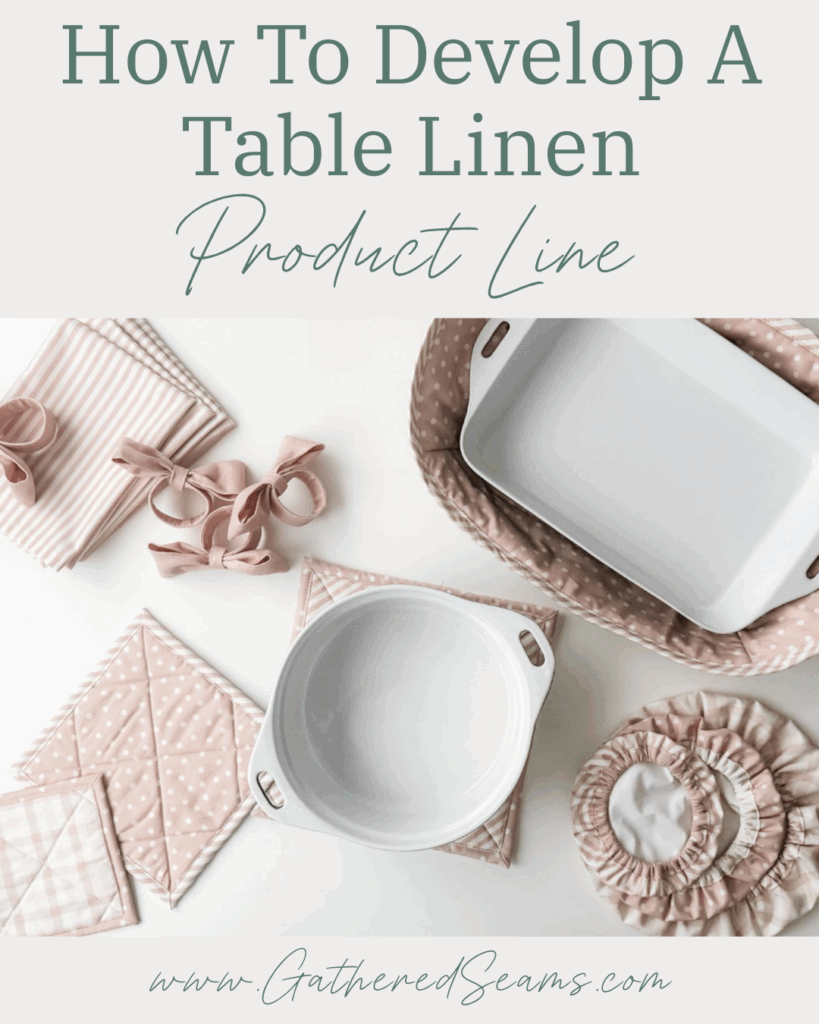
On the other hand, if you sell items such as hair accessories, your loyal customers are likely to purchase from you multiple times throughout the year. Selling an item such as an apron, next to matching oven mitts, potholders, tea towels, etc., ensures that there are other products that apron customers can come back to buy.
Whatever you’re thinking of making, look down the road and consider if there are other items you’re just as excited about that fit with that product.